
Chess Betting Odds 2026 — What Every Punter Should Know
 Available in US
Snapshot current as of October 30, 2026, verified against the Gambling Commission’s published register of remote betting licences.
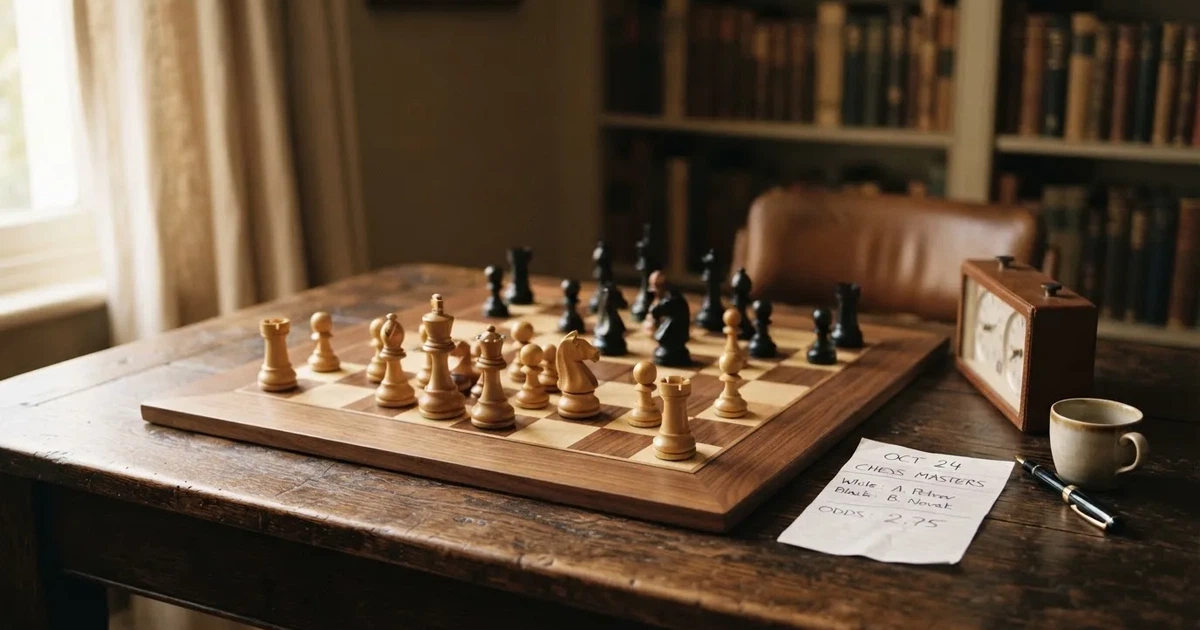
Chess sits in an odd corner of the British sportsbook. The sport has no statutory list of permitted events; what is and is not offered comes down to which operator bothered to build a chess product and how thin the liquidity on each event is. For a punter, that thin liquidity matters more than the headline odds suggest, because the bookmaker’s margin is wider on chess than on Premier League football or Championship tennis, and the qualifying conditions on welcome offers have been tightened by the Gambling Commission in ways that quietly change the arithmetic on a free bet. This guide works through what a chess bet actually is, how the odds are built, where the margin lives in the price, and what ten licensed operators do with the sport.
How Chess Bets Are Priced, and Why the Margin Is the Story
Chess looks straightforward because there are three outcomes per game: White wins (recorded 1–0), Black wins (0–1), and a draw (½–½). On a single board game the draw is more likely than either win at elite level, which is why the most common two-way market strips the draw out and offers only “White to win or draw” versus “Black to win”. The bookmaker then prices the stripped market as a two-outcome event with a margin that is wider than the equivalent outright on football, because the field of potential opponents is narrow, the modelling inputs are thin, and a handful of professional bettors account for a disproportionate share of the volume.

A bookmaker’s margin is the share of every pound staked across all outcomes of a market that the firm keeps regardless of which outcome wins. For a two-way market priced at decimal odds of 1.90 on each side, the payout share is 1 ÷ (1/1.90 + 1/1.90), which works out to 1 ÷ 1.0526, or about 95.0%. That 5.0% difference between 100% and the payout share is the margin. As a rule of thumb, a market priced at 1.91/1.91 carries roughly 2.3% in margin on each side; a market at 1.80/1.80 carries roughly 11.1%. The arithmetic is fixed: the shorter the odds, the wider the margin, because the margin and the price move in opposite directions on the same sum. On chess the prices tend to cluster in the 1.70 to 1.95 band on outright markets, which puts most of the margin between 5% and 15% — measurably wider than the 2% to 5% that holds on top-flight football 1X2 markets, and a difference a punter feels over a season.
The worked example here uses illustrative odds of 1.90 / 1.90 (fractional 9/10). It is an example, not a quoted price, and the same calculation governs every two-way market on the page. At those illustrative odds the margin sits at roughly 5%, the lower bound of the band a serious chess bettor should expect on most events. At the upper end, the band prices drop toward 1.70/1.70 and the margin rises toward 15% — the spread is wide precisely because the volume on most chess events is thin.
The three-way outright and why it looks generous
Most chess fixtures are priced as a three-way market: White wins, draw, Black wins. With a draw at elite level around 45–55% of decisive games, the draw is not a long shot, and the price on it is often 2.50 to 4.00 depending on the matchup. A 3.00 on the draw looks generous next to a 1.80 on either side, but the three prices together carry a margin wider than the two-way stripped version, because three outcomes each need their own share of the overround. A typical three-way chess market at 2.20 / 3.00 / 2.80 carries a margin of roughly 8% — wider than the 5% on the illustrative two-way example, and a useful reminder that “draw at 3.00” is not 3.00 of value for the punter.

What the margin hides
The margin is what every odds comparison site quietly buries. Two operators can list identical-looking 1.85 on the same player and one keeps 8% of stakes on that market while the other keeps 12%, and the headline price is identical to two decimal places. The only way to see it is to add up the implied probabilities across all outcomes and subtract from 100%. For a two-way market at 1.85/1.85 the implied probabilities sum to 108.1%, which means the margin is 8.1%. For a three-way market at 2.20/3.00/2.80 the implied probabilities sum to roughly 108.0%, which is a margin of 8.0%. Both look like 1.85 to the eye; neither is 1.85 of value.
A punter comparing prices on the same fixture across operators will see a one- or two-tick difference on most outcomes, and that difference is where the value lives. A 1.83 to 1.85 move on a 2.20 favourite shifts the margin by about one percentage point, and over a season of staking that one point is the difference between a winning and a losing record for a model-driven bettor.
Markets a Chess Punter Actually Bets On
The headline market is the match outright, but the bulk of volume on professional chess sits on a handful of tournament-level markets that operate on different cycles. The Candidates Tournament decides who challenges the reigning World Champion; the World Chess Championship match itself runs over fourteen games; the Grand Chess Tour and the Norway Chess round-robin sit under a tournament-points market; and rapid and blitz events, played under faster time controls, have their own outright and head-to-head markets with shorter odds cycles because the games are 10 to 25 minutes rather than several hours.
Gukesh Dommaraju won the World Chess Championship in 2024, becoming the youngest undisputed champion. The next title cycle’s Candidates Tournament and the World Chess Championship match itself form the calendar a serious chess bettor works to. Wilhelm Steinitz claimed the first universally recognised title in 1886; the lineage between those two bookends is the history the markets sit on top of.
Within a tournament round a punter can also bet on the spread — a handicap in games, not in points — and on whether a particular game will be decided (no draw) versus going to the draw. The deciding-game market tends to sit around 1.60 to 1.70 when one player is a heavy favourite, because elite chess produces a high draw rate at the top of the field and the odds reflect that. The draw-no-bet version, which refunds stakes on a draw, carries shorter odds than the outright and a wider margin, and the punter pays for the refund in price.
Live chess betting and how it actually works
Live betting on chess is not like live betting on football. There are no corners, no shots, no momentum that shifts the price every thirty seconds. The price on a chess game moves only when the operator reprices, which happens at key moments: after each capture, after a piece is offered in an exchange, when one player calls for the arbiter, and at the end of a game when the result is known. The market is thin enough that liquidity on any in-play chess fixture is small, and the operator’s automated re-pricing tends to lag by several plies — a situation a sharp bettor can read but a casual punter will misread.
What is actually offered in play tends to be the next-game winner in a match series, the outcome of the current game if the position has shifted decisively, and tournament-points markets that update only at the end of each round. The spread of in-play markets is narrower than on football or tennis, the cadence is slower, and the edge from timing the price is smaller than the marketing suggests.
Bet builders, accumulators and the rule that catches them out
Bet builders on chess exist at most of the operators reviewed below, but the sport is a poor fit for them. A bet builder combines markets from one event into a single bet; on football it lets a punter pair “match result” with “both teams to score” and price the combination. On chess the natural pairings — match result plus total games, or first-game winner plus series winner — multiply, but the underlying outcomes are correlated in ways the builder’s pricing model may not handle correctly. The builder gives the punter the convenience of one stake and one slip; what it does not give is a margin better than the sum of the two underlying margins, because the builder’s price already includes an additional overround of its own. The pricing looks generous because two short-priced outcomes are combined, and the actual margin is wider than either underlying market on its own.
Accumulator insurance — a refund as a free bet if one leg of a multiple lets a player finish — is offered by several of the operators below and applies to multiples generally rather than chess specifically. Whether it covers a chess-only accumulator is a question for the operator’s terms on the day, and the punter should check the eligible-events list before staking.
A Licence Means What It Says — and What It Costs
Every bookmaker reviewed on this page holds a remote licence from the Gambling Commission for betting on real events in Great Britain. The Commission’s public register is the test of whether a brand holds one: it can be searched by business name, trading name, domain or account number, and the entry shows the licence categories, the licence holder (which is not always the same company as the brand name), and the address the Commission has on file. A brand whose domain is .co.uk is not licensed by that fact alone; licensed operators use .com as well as .co.uk, and the domain proves nothing either direction. The licence is at the point of consumption: since the Gambling (Licensing and Advertising) Act 2014 an operator whose remote facilities are used in Great Britain needs a Commission licence wherever it is incorporated.
The relevant categories for chess are remote general betting standard (real events), which covers a single-match bet or tournament outright, and remote general betting limited, which covers smaller-stakes or restricted-event licences. A betting exchange licence is a separate category and is not held by any operator on this page. A separate licence is needed for virtual events and another for pool betting; a chess match does not fall under either.
A licence is not a quality mark. It is a permission to take bets from customers in Great Britain under the Gambling Act 2005 and the Licence Conditions and Codes of Practice. What it gives the punter is access to GAMSTOP, to the Commission’s complaints route, to the approved alternative-dispute-resolution body the operator is required to sign with, and to the source-of-funds checks the money-laundering rules require at higher spend. What it does not give is a guarantee of fair prices, of competitive margins, or of any particular depth of chess coverage. The Commission’s role is to keep the market honest at the regulatory boundary, not to keep the margins tight on the slip.
The verification that happens before the first bet
Since 7 May 2019 a licensed operator has to verify the customer’s name, address and date of birth before the first deposit, including when the first product is a free bet or bonus. The check is public-record based; it is not a credit reference check and it is not an income check. A punter cannot register, deposit, claim a welcome offer, place a single bet and withdraw without the operator having verified who they are. For a casual chess punter this means a longer sign-up than a Curaçao-licensed site offers; for the regulator it means the no-anonymous-play rule holds in practice.
At higher spend a financial vulnerability check applies: when deposits minus withdrawals cross £150 in a rolling 30 days the operator runs a public-record check (bankruptcy, county court judgments) under LCCP condition 3.4.4. The full financial risk assessments — the “affordability checks” that have featured in the press — are announced in stages, and no start date has been set. The check the punter actually meets today is the £150 vulnerability check, not the deeper affordability review.
Responsible Gambling in Practice
A licensed operator offers GAMSTOP self-exclusion (six months, one year, five years, or five years with auto-renewal), deposit limits the customer sets, timeouts, and links to GamCare (the National Gambling Helpline), GambleAware, NHS gambling clinics and Gamblers Anonymous. GAMSTOP is mandatory for online operators and has been since 31 March 2020; a customer who self-excludes through GAMSTOP is blocked from every licensed online operator and the exclusion runs for a further seven years after the chosen minimum period unless the customer asks GAMSTOP to remove it. The block covers online sites and apps; betting shops run their own self-exclusion scheme.
The £150 vulnerability check is the new line that bites. When a customer’s net deposits cross £150 in 30 days the operator runs the check and may decline further deposits. Whether the check triggers a soft decline, a request for further documents, or a hard stop is up to the operator and to the result of the check itself. The punter should expect a longer deposit process as deposits rise, and should not interpret that longer process as a sign the operator is being difficult — it is the licence condition working as written.
Bonuses carry their own caps. Since 19 January 2026 the maximum wagering requirement on a bonus is 10x: a £10 bonus at 50x wagering would need £500 of qualifying bets, and that bonus is no longer compliant. A £10 bonus at 10x needs £100 of qualifying bets, and the bonus must be paid in cash on completion unless the terms say otherwise. Mixed-product promotions — an offer that requires gambling on two or more product types such as betting plus casino — are banned. A “bet on football to get free spins” type of offer is no longer permitted at a licensed operator, and a chess-specific welcome that comes with a casino sweetener is no longer permitted either. The cap applies to bonuses with a wagering condition; whether it applies to a free bet with no wagering condition is not established in the published rules, and a punter reading the small print should look for the condition that governs the offer being claimed.
The credit-card ban has been in force since 14 April 2020 and covers credit cards and credit-card-funded payments through an e-wallet. Debit cards and bank-based payments are not covered. A punter who wants to fund an account with a credit card has to use a debit card or a bank transfer; the credit-card route through an e-wallet is not a way around the ban.
Mobile and App: How Chess Plays on a Handset
Most chess betting on a phone happens through the bookmaker’s app rather than a mobile site. The app gives a touchscreen-friendly betting slip, a faster in-play interface, push notifications on price moves and tournament starts, and (where supported) face or fingerprint login. The downside is that the app occupies storage, requires updates, and cannot be used on a handset the operator does not support.
Every operator on this page offers an app on the iOS App Store in Great Britain. The Android situation is more uneven: most offer an Android app through Google Play, but a few route Android customers through a downloadable APK on the operator’s own site because Google Play restricts real-money gambling apps in some jurisdictions. A punter who bets on Android should check the operator’s site for the install route before assuming the App Store listing is the only one.
Live streaming on the app is the feature that distinguishes a serious chess betting product from a checkbox entry. Most top-flight bookmakers stream the events they have rights to; on chess the rights story is fragmented and many apps offer only the live scoreboard, not the video. A punter who wants to watch the game they have bet on should check the streaming coverage on the specific event before staking, and should not assume the operator’s football-streaming coverage extends to chess.
What the app does not do
The app does not change the price. A bet placed on the app and the same bet placed on the desktop site have the same margin and the same overround; the only thing the app changes is the interface and the latency. A punter who bets on a fast-moving in-play market will see a price move faster on the app than on a desktop, and that faster move costs more in missed ticks than the marketing of “live betting in your pocket” suggests. The app is a delivery channel, not a price advantage.
Welcome Offers, Free Bets and the Cost Behind the Headline
The headline number on a welcome offer is the headline; the cost behind it is the wagering condition, the minimum odds, the expiry, and the cap on free-bet winnings. A £25 free bet sounds like a £25 gift; it is not, because the stake is usually not returned with a winning free bet, and the cap on free-bet winnings (where one applies) can cut the headline return by a third. The average value of a free bet whose stake is not paid back is the free-bet amount times (odds minus 1) divided by odds, multiplied by the payout share of the market being bet on. A £25 free bet at decimal odds of 2.00 on a market with a 95% payout share is worth £25 × (2.00 − 1) ÷ 2.00 × 0.95, or about £11.88 on average. That is the average value of the offer; it is not what the offer wins on any single bet, and a punter who reads “£25 free bet” as a guaranteed £25 of value has misread the small print.
The 10x wagering cap on bonuses since 19 January 2026 changes the arithmetic on every welcome that carries a wagering condition. A bonus whose plus and minus deposit plus bonus has to be turned over 10 times before withdrawal is at the new ceiling; a bonus at 35x is no longer offered by a licensed operator; and the punter who compares a licensed welcome to an offshore one should compare the total turnover, not the headline amount.
The expiry on a free bet is the other line that bites. Most welcome free bets expire in seven days from issue; a £25 free bet on a sport with a thin fixture list (chess included) is hard to place in that window unless the punter is ready to bet on release day. The expiry is set by the operator, not by the regulator; the regulator’s rule is the 10x cap and the mixed-product ban, not the expiry.
The Ten Reviewed Bookmakers
Each operator below holds a remote licence from the Gambling Commission for real-event betting and offers chess under that licence. The reviews cover licence status, what the operator states on the key terms, and the angle that distinguishes the brand in a comparison.
Betfred
Betfred is one of the established high-street names operating online under a Petfre (Gibraltar) Limited licence (Commission account 39544). The app covers twenty-one sports and over two thousand casino-style games, which puts chess inside a wider product rather than a niche focus. A chess punter will recognise the familiar brand, though the chess market remains a secondary feature of the broader sportsbook.
BetMGM
BetMGM’s UK sports welcome is four £10 free bets — two football accumulators of four or more selections and two sports multiples of two or more — triggered by a £10 deposit and a first sports bet within seven days. The free bets are valid for seven days and have minimum-odds and opt-in conditions. The operator is licensed under LeoVegas Gaming PLC (Commission account 39198). For a chess punter the angle is the multi-product welcome: two of the four free bets are football-specific, and only the two sports multiples are usable on chess. The headline “£40 in free bets” overstates what a chess-first punter can actually use.
Bet600
Bet600’s headline product is Best Odds Guaranteed on horse racing: if the starting price is bigger than the early or show price taken, the bet is paid at the SP. The operator is licensed under Tyche Tech Limited (Commission account 44731). For a chess punter, Best Odds Guaranteed is irrelevant on the outright markets; the angle here is a smaller, racing-led product rather than a chess specialist. A chess punter using Bet600 is using the bookmaker as a small-stake complement rather than as the primary account.
10bet
10bet’s sportsbook covers football, tennis and horse racing, with cash out, a bet builder and live streaming. The operator is licensed under Blue Star Planet Limited (Commission account 43173). The bet builder is available, yet its pricing efficiency on chess should be measured against other sites.
DragonBet
DragonBet’s app is published by DragonBet Ltd (Commission account 64908) and features Welsh football and rugby, racing, American football, in-play and bet builder markets. DragonBet is a regional bookmaker whose focus on local Welsh fixtures means that its chess offering is supplementary to the main product.
Fitzwilliam Sports
Fitzwilliam Sports describes itself as a Dublin bookmaker with capped membership; the welcome is a High Stakes Welcome subject to compliance criteria. The operator is licensed under SBKI Limited (Commission account 48760). Instant deposits, fast withdrawals, timeouts and deposit limits are stated, and the site links to GambleAware, GAMSTOP and Gamblers Anonymous. This operator caters to higher-stakes bettors; its chess coverage is provided as part of a general sporting remit rather than as a primary focus.
Bar One Racing
Bar One Racing has rebranded as BAR 1 Betting; it is an Irish independent bookmaker with shops across Ireland and horse racing sponsorships at Dundalk, Fairyhouse, Navan, The Curragh, Curraheen Park and Cork. The operator is licensed under Bar-One Racing Limited (Commission account 56516). For a chess punter the angle is a racing-focused Irish independent; chess sits at the edge of the product, and the punter using BAR 1 is using it for racing rather than chess.
Midnite
Midnite’s site cites Gambling Commission licence 101839 (account 101839) and shows in-play events, an acca builder, popular accas and price boosts with maximum-stake limits. The sports welcome for new UK customers is £25 in free bets and 50 free spins on a £5+ pre-match bet at EVS (2.0) or greater within 14 days; the free bets and spins are valid for seven days. For a chess punter the angle is a newer UK operator with a sportsbook built around the mobile app, an acca builder that works across chess and other sports, and a welcome that is usable on chess when the pre-match odds of 2.0 or greater are met. The 14-day window for the qualifying bet is wider than the 7-day window on most rivals, which gives more time to find the chess fixture.
Paddy Power
Paddy Power is licensed under PPB Counterparty Services Limited (Commission account 39439) and its app covers football, horse racing, boxing, rugby, tennis, golf, darts, snooker and F1. For a chess punter the angle is the high-street familiarity and the broad sport coverage; the chess product sits inside a much wider sportsbook, and the price on a specific chess fixture should be compared against the operator’s rivals before staking.
NetBet
NetBet’s sportsbook offers Daily Boosts, Profit Boosts and free bet offers, a Bet Builder with instant dynamic odds, and sports stats for major leagues. The operator is licensed under Netbet Enterprises Limited (Commission account 39170). For a chess punter the angle is the bet builder with dynamic odds and the daily boosts, both of which apply across the sportsbook. The chess product is mainstream rather than specialist, and a punter who likes the bet builder mechanic for football can use the same mechanic on chess with the caveat on pricing above.
How a Price on a Chess Bet Is Built, in One Calculation
The mechanics of a market on a chess fixture work the same way as on any other sport. The bookmaker takes the true probabilities of each outcome, builds a margin into each price, and rounds the resulting decimal odds to two places. The punter sees the rounded price and works backward from it to an estimated margin by adding up the implied probabilities of all outcomes and subtracting from 100%.
For a two-way market at decimal odds of 1.90 on each side, the implied probability per outcome is 1 ÷ 1.90, or about 52.63%. With two outcomes the implied probabilities sum to about 105.26%, and the margin — the gap between 100% and that sum — is about 5.26%. As a band: a two-way chess market priced at 1.90 on each side carries a margin of roughly 5%; the same market at 1.85 carries about 8%; the same market at 1.80 carries about 11%. The lower the odds, the wider the margin, and the wider the margin, the less the punter keeps of every pound staked.
For a three-way chess market at illustrative odds of 2.20 / 3.00 / 2.80, the implied probabilities are about 45.45% / 33.33% / 35.71%, which sum to about 114.49%. The margin on this market is about 14.49% — wider than the illustrative two-way example above, and a useful rule of thumb that three-way markets are more expensive for the punter than two-way markets on the same fixture. A punter looking for the best value on a chess match will usually find it on the two-way stripped market rather than the three-way outright, even when the inclusive draw price looks generous.
The band the punter should expect on a single chess fixture is roughly 5% to 15% margin, depending on the number of outcomes and the popularity of the event. The Candidates Tournament and the World Chess Championship match itself sit at the lower end of the band; a Challenger-level rapid event sits at the upper end. Anything wider than 15% on a fixture the punter has shopped around is a sign that one operator is out of line, not that the market is overpriced across the board.
The Verdict on This Market
The honest summary on chess betting odds in Great Britain for 2026 is that the sport is offered by every operator reviewed on this page, the odds are structured as they are across the wider sportsbook, and the margin is wider than on the major team sports because the volume is thin and the modelling is shallow. A punter who bets on chess regularly will find value by shopping across operators on each fixture, by preferring the two-way stripped market over the three-way outright, and by treating the welcome offers as a way to learn the operator rather than as a source of sure returns.
The wider context matters. A Gambling Commission licence buys the punter access to GAMSTOP, the Commission’s complaints route, the approved alternative-dispute-resolution body, and the source-of-funds process; it does not buy tight margins or deep chess coverage. The 10x wagering cap since 19 January 2026 has lifted the floor under what a compliant bonus looks like, and the £150 financial vulnerability check has tightened the journey for a customer whose net deposits rise. Both moves favour the disciplined punter and cost the undisciplined one.
The bookmakers on this page are not in a ranking. They are ten licensed operators with a stated chess product, each reviewed on the same four lines: who holds the licence, what the operator states on the key terms, what the operator’s angle is in a comparison, and what the punter should check in the small print before staking. The decision between them is a punter’s call, not the page’s, and the table below sets out the facts the call rests on.
Licence Register of the Ten Operands
| Brand | Licence | Licence holder |
|---|---|---|
| Betfred | 039544-R-319290-010 (39544) | Petfre (Gibraltar) Limited |
| BetMGM | 039198-R-319450-029 (39198) | LeoVegas Gaming PLC |
| Bet600 | 044731-R-323941-016 (44731) | Tyche Tech Limited |
| 10bet | 043173-R-322899-023 (43173) | Blue Star Planet Limited |
| DragonBet | 064908-R-339041-003 (64908) | DragonBet Ltd |
| Fitzwilliam Sports | 048760-R-335434-009 (48760) | SBKI Limited |
| Bar One Racing | 056516-R-332750-007 (56516) | Bar-One Racing Limited |
| Midnite | 101839-R-342850-001 (101839) | Midnite Limited |
| Paddy Power | 039439-R-319330-013 (39439) | PPB Counterparty Services Limited |
| NetBet | 039170-R-319343-032 (39170) | Netbet Enterprises Limited |
The table lists the remote general betting standard (real events) licence for each reviewed brand. The Commission’s public register carries the full record.
Frequently Asked Questions
Where can a punter bet on chess in Great Britain?
A punter can bet on chess at any online bookmaker licensed by the Gambling Commission for real-event betting. The ten operators reviewed on this page are all licensed; the Commission’s register lists every licensed brand and is searchable by name, domain or account number. The licence covers chess under the general real-events category; there is no separate licence type for chess.
Is betting on chess legal in Great Britain?
Yes, provided the operator holds a Gambling Commission remote licence for real-event betting and the customer is at least 18 and verified. The Gambling Act 2005 covers England, Scotland and Wales; Northern Ireland is outside the Act and runs its own older law. A Curaçao, Maltese or Gibraltar licence alone is not a substitute for a Commission licence when the bet is taken from a customer in Great Britain.
How does a punter place a bet on a chess match?
A punter registers with a licensed operator, verifies name, address and date of birth, deposits by debit card or bank transfer (credit cards are banned for gambling), selects the chess fixture from the sportsbook, chooses a stake within the operator’s limits, and confirms the bet on the slip. The payout on a win is stake × decimal odds; the profit is stake × (odds − 1). The bet settles when the operator receives the official result.
How is a Gambling Commission licence verified?
By searching the Commission’s public register at the regulator’s own site, by business name, trading name, domain or account number. The entry shows the licence categories, the licence holder, and the address the Commission has on file. The register is the whole test of whether a brand holds a licence; the domain extension and the brand name prove nothing.
How is the return on a winning bet calculated?
The return is stake × decimal odds. For a £10 stake at 2.50, return = £25; profit = £15. For an accumulator the odds of the legs multiply into one price before the stake is applied, and the same formula holds. The bookmaker’s margin is built into the price and is the gap between 100% and the sum of the implied probabilities across all outcomes of the market.
What is the bookmaker’s margin and how is it read in the odds?
The margin is the share of every pound staked across all outcomes of a market that the bookmaker keeps regardless of which outcome wins. For a two-way market at decimal odds of 1.90 on each side, the margin is about 5%; the same market at 1.85 carries about 8%; the same market at 1.80 carries about 11%. The lower the odds, the wider the margin, because the margin and the price move in opposite directions on the same sum.
Tennis, darts & cue sports – Icehockeyoddshub.com
Content created by the «Icehockeyoddshub.com» team
