
How to Turn Badminton Betting Tips Into Better Bets
 Available in US
October 30, 2026 · Verified against the UK Gambling Commission’s public register.

A tip is not a winning bet. A tip is someone else’s read on a match — the form, the head-to-head, who is fresh, who is nursing a shoulder, who has the crowd behind them — and the price a bookmaker is offering against it. The only part of that sentence a reader controls is the price. Everything that turns the tip into a bet, or keeps it from being one, lives inside the price, and the price lives inside whatever margin a bookmaker has taken. This page works back from that: how a tip is built, what makes one genuinely worth following, what a bookmaker’s margin takes out before you even start, and what it costs to clear a bonus once you’ve placed the bet. It reads better as an ordering than as an answer key, because the ordering is the part a bettor keeps.
What a “Tip” Actually Is and Why No Tip Is Ever Certain
A tip starts as research — win-loss records, recent match-ups, head-to-head history, minutes on court, fitness, tournament stage, even altitude for the Asian swing. A good tip puts weight on the right handful of those factors; a bad tip dresses up a hunch as research. Either way, the tip is a view of which player *might* win. The probability that view assigns is the price a tipster would call fair. Real matches don’t follow models, and the closer you watch badminton the clearer that becomes: a side’s first serve can wobble half an hour before it stops wobbling, and the player who was cruising at 11-4 can be serving for the game at 11-9.

A tip becomes actionable when its price is *above* the true probability — when the bookmaker offers more than the bet is actually worth. That’s a value bet, and it is the only mechanical reason to follow a tip rather than the other way around. The bookmaker does not agree on probability; it agrees on margin. A tipster who says “I like Player A” without a price, and cannot tell you at what price Player A is worth backing, has handed you half a tool.
Two further limits follow. First, even a textbook value bet loses more often than it wins, because the price reflects a probability below one in two for most underdogs and the juice sits inside it. Second, the only number under a bettor’s control is stake size. Flat-stake or proportional staking — the same unit a bet, or a fixed percentage of bankroll — keeps a losing run from wiping out the winning runs that come before it. A bankroll grows on discipline more than on tips.
The routine is unglamorous and rarely shortened: open a tipsters’ site or feed, narrow to one or two BWF events with full data, compare the tipster’s price to the bookmaker’s price, back only where there’s a gap worth the unit stake, and log every bet, price and result in a spreadsheet. The spreadsheet does two jobs — it shows whether a tipster’s edge is real over a couple of hundred bets, and it stops a bettor from rewriting the losing ones in memory.
Reading Bookmaker Odds and the Margin They Hide
Badminton is a two-player or two-pair game at almost every level that matters, and the dominant market is the match winner, with a price for each side. Decimal odds work the way a calculator works: at 1.91, a £10 stake returns £19.10 if the side wins, and that £19.10 is the bettor’s *return* — stake plus £9.10 of profit. British fractional odds name the profit instead: 10/11 means £10 of profit for every £11 staked. Conversion is mechanical — decimal equals fractional numerator divided by denominator plus one (10/11 → 1.91, 5/1 → 6.00, evens → 2.00) — but a bettor who sets the bookmaker’s odds preference to one format saves having to do it under stress.
Beneath the two prices sits a layer most bettors never see. On a fair coin toss a bookmaker would offer 2.00 against each side and earn nothing. A bookmaker that quotes 1.91 against each side does not lose money on the toss — it earns roughly 4.5% on every pound bet, because the two prices imply probabilities (1 ÷ 1.91 = 52.4% on each side) that add up to 104.7% rather than 100%. The extra 4.7% is the overround; the margin is the bookmaker’s take before a result is even decided, which at these odds is 4.5%.
The illustrative two-way market at decimal odds 1.90 / 1.90 — a notional price for the math, not a quote from any operator — implies 1 ÷ 1.90 = 52.6% on each side, summing to 105.3%, an overround of about 5.3% and a margin of 5.0%. Real margins on badminton match-winner markets drift with the depth of the field and the time to first serve: a quiet early-round match may sit closer to 7%; a marquee men’s singles final between two well-known players can tighten to 3-4% as each operator tries to attract the bet on both sides. The headline price is the first number a bettor reads; the margin is the number a bettor *should* read first.
A worked example on the same illustrative numbers: a £100 stake on Side A at 1.90 returns £190 if it wins; a £100 stake on Side B at 1.90 returns £190 if it wins; together the bookmaker keeps whatever falls short of £200 of the two stakes that have been settled — that is, £10 on a £200 handle. A bettor’s job on every market is to find prices with thinner margins, because a thin margin on the same match lets the same edge pay a higher price and survive a longer losing run.
Bet Types That Show Up at a Badminton Bookmaker
Match winner is the backbone and the right place to start, but most bookmakers serve several more, and the shape of each bet changes what “value” means.
Set winner settles on the winner of a specific game inside a match, paid off after one of the three possible games. It lets a bettor back a side that tends to start slow or qualify through a slow round-robin, without backing them across the whole match. The price is shorter because the bet settles on a smaller unit of time.
Handicap — sometimes called a games handicap — gives one side a notional head start or deficit measured in games. A favourite at -1.5 games needs to win 2-0; an underdog at +1.5 games is paid out if they take a game. The market is popular because even a modest favourite tends to drop a game in a three-game match, and the handicap moves the price closer to a coin toss for marginal ties.
Over/under total games is the standard match-length bet. The line sits at 2.5 for best-of-three, which means “over” means three games played and “under” means the match finishes in two. Because three-game matches are statistically more common in women’s badminton than men’s, the price on 2.5 is not always the same on both sides.
Outright tournament winner is a futures bet on the BWF World Championships, the All England Open, the Thomas Cup, the Uber Cup or the Sudirman Cup. The price on Player A to win outright will be longer than the price on Player A to win their first match, because outright prices compound several rounds of probability. The catch: only one stake is lost per tournament outcome rather than per match, so outrights work as a small-stake, longshot bet rather than a unit-stake accumulator.
Accumulators — “accas” — string several selections into one price. A treble of three matches at 1.50 each pays 3.375 if all three win — a tempting number next to the smaller singles, and a mathematically punishing one once each leg’s own margin is included. The house takes its cut on every leg, then compounds it across the ticket. BoyleSports offers acca insurance at a £5 minimum stake and 1/2 minimum odds, refunding up to £20 as a free bet that expires in 7 days if one leg lets the rest down — a small comfort that still costs the bookmaker less than it saves the bettor.
Bet builders and same-game multis let a bettor combine several markets on the same match into a single price: match winner plus over 2.5 games plus Player A to win the first game, and so on. They look generous because the cumulative odds multiply. They are not generous; the margin is multiplied too, and the more legs the ticket has the larger the bookmaker’s edge.
Cash out lets a bookmaker buy a bet back mid-match at a price it sets in real time. The price is fair on average but skewed by what the in-play feed implies, and a bettor who cashes out routinely hands back the long-run edge the original price offered.
How the Sport Actually Decides a Match
The fundamentals matter because a tip built on them is a tip that respects the sport.
A badminton game runs to 21 points with rally-point scoring — every serve wins a point, no second-serve for the receiver — and a match is the best of three games. At 20-all play continues until one side leads by two; at 29-all the next point wins, so the longest possible game is 30 points. Most men’s singles matches finish in two games; most women’s matches finish in three, which is why “over 2.5 games” sits at a different price from “under”.
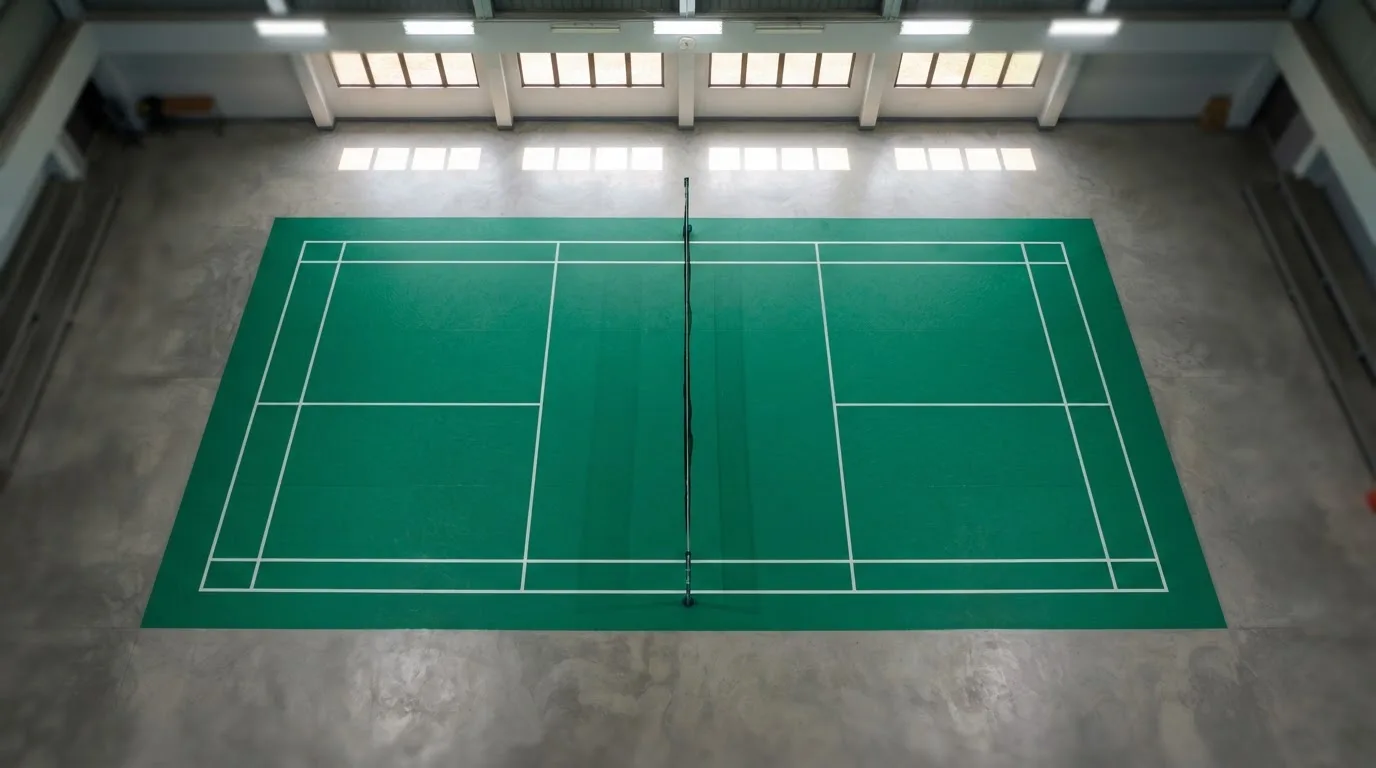
The court is 13.4 m long, 6.1 m wide for doubles and 5.18 m wide for singles, with a net 1.55 m high at the edges and 1.524 m at the centre. The half-court widths shape how matches play out: singles rewards reach and angles, doubles rewards the rotation and the smash from midcourt. Five disciplines sit under the BWF’s umbrella — men’s singles, women’s singles, men’s doubles, women’s doubles, and mixed doubles — and a bookmaker that covers the men’s game properly covers the women’s game and at least the mixed doubles of the Super Series.
The sport has been an Olympic event since Barcelona 1992, with mixed doubles added four years later in Atlanta. The team competitions — the Thomas Cup for men, the Uber Cup for women, the Sudirman Cup for mixed teams — are held every two years, and the Thomas and Uber Cups share a host city and a fortnight. The All England Open dates from 1899, the BWF World Championships from 1977, and a BWF calendar in 2026 carries all of it.
The UK Legal Frame for Badminton Betting
Badminton betting in Great Britain is regulated by the Gambling Commission, a non-departmental public body sponsored by the Department for Culture, Media and Sport. The framework is the Gambling Act 2005, amended by the Gambling (Licensing and Advertising) Act 2014 so that any operator whose remote facilities are used in Britain needs a Commission licence wherever the company is based. The Act covers England, Scotland and Wales; Northern Ireland sits under different law and is outside what a GB-licensed operator covers.
For an online bookmaker the relevant category is a *remote general betting standard* licence for real events; for a betting exchange it is a separate *betting intermediary* licence. Each category appears on the Commission’s public register, which can be searched by business name, trading name, domain or account number, and which is the only test that matters of whether a brand holds a licence. Operators may use .com as well as .co.uk, so the domain alone proves nothing; the register proves everything.
The minimum age is 18, and identity checks are run before the first deposit or bet — name, address, date of birth — so no anonymous play is available at any licensed brand. Credit cards have been banned for gambling in Britain since 14 April 2020 (LCCP condition 6.1.2), a rule that covers credit-card-funded e-wallet top-ups too. Debit cards and bank transfers are not covered by the ban. A player in Britain pays no tax on betting winnings (general information, not advice; a professional gambler should ask HMRC or an adviser); the operator pays General Betting Duty, currently 15% of gross profits, with a new 25% rate for remote bets from 1 April 2027, while remote bets on UK horse racing, pool betting and in-person betting remain at 15%.
Responsible Gambling Tools at a Licensed Bookmaker
Every GB-licensed remote bookmaker joins GAMSTOP, the national multi-operator online self-exclusion scheme that has been a mandatory licence condition since 31 March 2020. Self-exclusion periods are six months, one year, five years, or five years with auto-renewal; the minimum period runs out, and after that a further seven years of exclusion stays in place unless the customer asks GAMSTOP to lift it. GAMSTOP covers online sites and apps; betting shops run a separate service. The exclusion cannot be removed inside the period.
Financial vulnerability checks sit on the operator side: since 30 August 2024, LCCP condition 3.4.4 has required a public-record check (bankruptcy, county court judgments and similar) at the point a customer’s net deposits exceed £150 across a rolling 30 days (live since 28 February 2025). It is not a credit check and not an income check; broader financial risk assessments — the press calls them affordability checks — have been announced and staged, with no start date. Deposit limits, set by the customer, are mandatory for the operator to offer on a fixed time frame (RTS 12), with first changes live since 31 October 2025 and a second phase postponed to 30 September 2026; whether that second phase is in operation is not established. There is no state-set ceiling on what a customer may deposit or stake.
In-app tools complement the statutory ones. Unibet’s safer-gambling set runs to deposit limits, a Player Profile test, product restrictions and self-exclusion, with live chat support and pointers to BeGambleAware, GamCare, GAMSTOP, Gambling Therapy and the BGC. The summary holds for most of the brands reviewed below: limits, time-outs, product blocks, reality checks and self-exclusion are table stakes, and a brand without them is not licensed.
Help outside the operator sits with GamCare (which runs the National Gambling Helpline), GambleAware, the NHS gambling clinics and Gamblers Anonymous. A bettor who feels the unit-stake rule beginning to slip has a fast route to a conversation that does not have to start with the bookmaker.
Bonuses, Free Bets and What They Cost to Clear
A “bonus” is marketing before it is value, and the same is true of a “free bet”. The shape of each offer varies; the cost of clearing it is consistent across the market and worth reading before claiming.
The headline rule from January 2026: wagering requirements on bonuses are capped at 10x (a £10 bonus at 50x would have needed £500 of bets; under the cap it needs no more than £100). Mixed-product promotions — an offer that ties betting to casino, bingo or lottery, like “bet on football to get free spins” — are banned. Where the cap leaves free bets with no wagering condition, and any cap on the money value of a bonus, are not established.
The offer types look like this in real terms.
Matched deposits and “risk-free” bets promise the stake back as cash or free bet if the first bet loses. A free-bet refund is not a cash refund: the free-bet stake is usually not paid back with a win, so a £50 free bet at 1.91 returns £95.50 of *profit* plus nothing of the stake — net £95.50, against a £100 cash refund on a losing stake. The headline reads as identical; the math is not.
Price boosts and acca insurance change the price of an existing selection or refund a stake if one leg of an acca fails. BoyleSports’ acca insurance is a clean example: opt-in, a £5 minimum stake, minimum odds 1/2, a maximum £20 free-bet refund if one leg lets the rest down, and a 7-day expiry on the free bet. The bet must be placed and settled on the same day, so the bonus bookends a single day’s play.
Best Odds Guaranteed is the racing equivalent of a price boost, and several brands reviewed below extend it. William Hill pays BOG on UK and Irish horse racing from 8 AM on the day of the race, on both singles and multiples, and excludes ante-post, tote and pari-mutuel bets. Copybet offers BOG all day on every UK and Irish race, and pays first past the post on horse racing even when the winner is later disqualified. Bet600 pays the starting price if it is larger than the early or show price taken. None of these rules apply to badminton — they appear here because most BOG brands carry the wider bookmaker offer a bettor on badminton inherits.
The hard cost of a bonus is the turnover it demands. A £50 bonus at a 5x wagering factor requires £250 of qualifying bets at the minimum odds the terms set, typically 1/2 (decimal 1.50), and on the markets the terms exclude. At a market margin of 6% the expected cost of that turnover is £250 × 0.06 = £15, before the £50 bonus has been paid out. The math reverses “free” into “£15 to claim £50”, which is a different proposition. The rules around accredited UK betting promotions on badminton run in exactly the same arithmetic, and they are worth reading carefully on each operator’s terms page before opting in.
Live Badminton Betting and Cash Out
In-play betting on badminton is offered by most GB-licensed brands, with bet365 among the broadest — its in-play product runs alongside live streaming of events worldwide, a bet tracker for following markets after the bet has gone down, and a live golf tracker for a sport that the same platform covers. Swifty Sports lists in-play betting, daily price boosts and live streaming, with a Bet Builder marked as coming soon. The in-play market brings two specific costs on top of the standard margin.
First, in-play margin runs higher than pre-match because the bookmaker is pricing on a partial-information feed and pricing into uncertainty. The match-winner price at 1.91 pre-match may tighten to 1.95 mid-game when one side opens a five-point run — the kind of movement a bettor who reads the run quickly is supposed to use. The bookmaker that sees the run first widens its margin, and that fact is built into the in-play product across the market.
Second, cash out is the bookmaker’s mid-match buyback. The buyback price is fair on average across many bets; it is unfriendly on the single bet, because the buyback factors in what the in-play feed implies about the bet plus a margin of its own. A bettor who cashes out routinely hands back the long-run edge the original price offered.
Live streaming matters because it is the half of in-play the bettor does control. A feed that shows the second-serve wobble gives the bettor a stream of information the bookmaker cannot price faster than the bettor reads it; a feed that shows only the score does not. The brands reviewed below differ widely on which BWF events stream live to a logged-in customer, and the difference is worth taking as seriously as any margin comparison.
The Ten Bookmakers Compared
The brands below each hold a Gambling Commission remote licence for real-event betting in Great Britain, and each appears on the Commission’s public register under the account number listed. A licence is not a recommendation and not the same thing as a place in a comparison; the write-ups below pull out what each brand actually does for a bettor looking at badminton in 2026.
1. Ladbrokes — the established exchange-era bundle
Ladbrokes runs under Commission account 54743, the licence held by LC International Limited. The product range is broader than most: odds boosts on horse and greyhound bets, Best Odds Guaranteed on UK and Irish racing, in-play betting and Acca Boosts, all on a brand that has been on the British high street since the days when that phrase meant something. Badminton sits inside the wider sportsbook without a flagship tournament series, which is typical of brands where the size of the menu hides any single sport — a feature rather than a fault for the bettor who wants depth in tennis, racing and football at the same time. The downside for the badminton specialist is also the upside: there is no bid to be the best badminton bookmaker, only to be a complete one.
2. Copybet — best odds guaranteed as the headline
Copybet holds Commission account 53774 under Copybet UK Limited, and bets its brand identity on Best Odds Guaranteed all day, every day, on UK and Irish racing. First-past-the-post is paid even when the winner is disqualified. Badminton is a side product here, alongside the racing spine, and the bettor looking for a price boost on a BWF event will be served well if the event is large enough to have a price boost attached. The narrower product range works for the racing-led bettor; a bettor whose week is half badminton and half Premier League should compare more widely before settling.
3. BoyleSports — acca insurance with crisp terms
BoyleSports sits under Commission account 39469, with Boylesports Enterprise as the licence holder. The acca insurance is the headline offer: opt-in, £5 minimum stake, 1/2 minimum odds, a maximum £20 free-bet refund if one leg fails, a 7-day free-bet expiry, bets placed and settled on the same day. The terms are crisp enough that a bettor can tell, before staking, what the offer is worth on a Sunday acca. Badminton coverage sits inside a brand more famous for its Irish and UK racing sportsbook; the bettor who values the insurance more than the depth of the in-play feed is well served.
4. BetTom — fifty-fifty welcome bundle
BetTom holds Commission account 64959, with Bet Tom Limited as the licence holder, and offers a sports welcome offer of 50% back as a free bet up to £50 plus a matching 50% back up to £50 in free slot funds for casino play. The split between sportsbook and casino is the central fact: a bettor who only bets on badminton picks up the sportsbook half and ignores the casino half, and the matched 50% on each side is more generous than most single-product welcomes. Full terms apply, and the wagering factors on the casino free slot funds are a separate read from the sportsbook free bet. The sportsbook itself is mid-sized and not differentiated on badminton; the welcome offer is the reason to look at it.
5. Tote — pool betting on the racing calendar
Tote holds Commission account 54779, with TDCO Limited as licence holder. The brand is built around pool betting on UK and Irish racing and a more limited sportsbook; badminton sits inside the sportsbook as one of several sports, and a bettor looking for tournament-level BWF pricing will find less here than at the wider sports brands. Best Odds Guaranteed is part of the wider racing offer from 8 AM on the day, on singles and multiples, excluding ante-post and pool markets. The case for Tote on badminton is the case for Tote everywhere — a brand that does one thing (pools) well and a sportsbook that is acceptable beside it.
6. Swifty Sports — the streaming-led newcomer
Swifty Sports holds Commission account 58957, with Swifty Global (UK) Ltd as the licence holder. The product list reads modern: Best Odds Guaranteed, Cash Out on horse racing and football, daily price boosts, live streaming and in-play betting, plus a Bet Builder marked as coming soon. Live streaming is the differentiator on a brand newer to the GB market than most — the bettor whose discipline is in-play and who wants to watch while betting has more reason to be here than a bettor who places a Sunday-morning acca and forgets the sport for six days. Badminton is covered; the depth of that coverage depends on the BWF’s broadcasting agreements in any given season.
7. Fitzdares — premium service, narrower market
Fitzdares holds Commission account 400 under Fitzdares Limited, the smallest account number on the list and a marker of how long the brand has been trading in Britain. The product is positioned as premium: cash out, accumulators, Lucky 15s, specials and antepost markets across horse racing, football, tennis, rugby, cricket, golf and American football, with in-play live odds. Badminton is a smaller piece than those listed, and the bettor looking for an in-play price on a BWF Super Series event can find it here but should not expect the depth of a bet365 or a Ladbrokes. The verdict is the verdict on every Fitzdares product: better-than-average for the customer who values the brand’s range, narrower than the Goliaths for the customer who wants every market on a single screen.
8. Betmaster — operator-led compliance signal
Betmaster sits under Commission account 65699, with BM Solutions GB Ltd as the licence holder. The brand states the licence number and terms clearly on its home page, which is the compliance pattern UKGC expects: a customer who lands at the page can find the licence in under a minute, look it up on the Commission’s register, and confirm the brand without leaving the page. The product itself is a full-service sportsbook with in-play, casino and the standard promotions — not differentiated on badminton, not narrow enough to be a weakness. A bettor looking for a clean, licensed sportsbook with a normal BWF offering finds it here.
9. Bet600 — starting price as the headline
Bet600 holds Commission account 44731, with Tyche Tech Limited as the licence holder. The headline offer is Best Odds Guaranteed on horse racing, paying the starting price if it is larger than the early or show price taken. Badminton is one of several sports on a sportsbook that has not carved out a niche on its own; the bettor looking for a no-frills licensed bookmaker with a normal price on every BWF event finds what they are looking for, without the bonus bookends or the brand identity some of the larger competitors trade on.
10. bet365 — the in-play yardstick
bet365 holds Commission account 55148 under Hillside (UK Sports) ENC. In-play betting and live streaming of events worldwide, plus Bet Track, Match Live and a Live Golf Tracker, sit on a sportsbook whose product range few GB brands match. The badminton offering follows the BWF calendar across singles, doubles and mixed, with in-play markets and live streams at the major events. The Bet Builder and same-game multi run across sports with the same accumulation-by-multiplication pricing logic as elsewhere; the difference is the volume of markets, which lets the bettor find the niche bettor-friendly price in a way smaller books cannot match. The yardstick problem is the yardstick itself: a brand that sets the bar for in-play makes every other brand look slow, but its margin on badminton — and every book’s margin — sits inside the headline price regardless.
How These Brands Compare on Licence
| Brand | Licence account | Licence holder | Coverage of badminton |
|---|---|---|---|
| Ladbrokes | 54743 | LC International Limited | Full BWF calendar; in-play |
| Copybet | 53774 | Copybet UK Limited | Racing-led; standard BWF coverage |
| BoyleSports | 39469 | Boylesports Enterprise | Sportsbook-wide; standard BWF coverage |
| BetTom | 64959 | Bet Tom Limited | General sportsbook; standard BWF coverage |
| Tote | 54779 | TDCO Limited | Limited; racing-led |
| Swifty Sports | 58957 | Swifty Global (UK) Ltd | In-play and streaming focus |
| Fitzdares | 400 | Fitzdares Limited | Premium; selective BWF markets |
| Betmaster | 65699 | BM Solutions GB Ltd | General sportsbook; standard BWF coverage |
| Bet600 | 44731 | Tyche Tech Limited | General sportsbook; standard BWF coverage |
| bet365 | 55148 | Hillside (UK Sports) ENC | Full BWF calendar; in-play and streaming |
Licence numbers are the Commission’s account numbers, searchable on the public register by business name, trading name or domain. A licence verifies the regulatory frame, not the depth of coverage; the depth of coverage is what each brand’s own sportsbook shows.
Reading a Tipster’s Work Without Losing Money Reading It
The bulk of free and subscription tipster content online is supposed to do one job — turn opinion into probability — and the test of whether it has done that job is whether the tipster publishes closing prices, settled results and a long-run record. A tipster with 200+ bets behind them, an audited closing-line value above zero and a willingness to publish losing weeks is a different proposition to a tipster with no record and a Twitter handle.
Three habits keep tipster-reading from getting expensive. First, stake the same unit on every bet, regardless of confidence — staking larger on a “strong” tip is exactly the staking pattern that empties a bankroll. Second, back at the closing price or the best available price, not the price when the tip arrives; the edge is in the gap, and the gap closes as kick-off approaches. Third, log everything — selection, price, stake, bookmaker, result — in a spreadsheet that does the winning-week selective-memory correction for the bettor. The bettor who keeps the log and reads it once a month has a better handle on whether the tipster edge is real than the bettor who reads the tipster’s weekly email.
When a Tip Says Two Things at Once
A tip that arrives with two prices — “back Player A at 1.91 or better, otherwise lay Player A at the exchange if available” — is the textbook value bet. The bettor reads it as a single answer because the tipster has already done the price comparison: backing below 1.91 is not worth the edge; laying above the lay price earns from the backer’s loss. The shape turns every tip into a two-sided instruction, which is what an exchange lets a bettor act on.
Most GB-licensed bookmakers do not run an exchange. Paddy Power and Betfair share infrastructure across the same operator; both are part of the same Flutter group and use a single betting exchange under the betting intermediary licence. A bettor looking for a lay price on a BWF event should check whether the operator sits under a betting intermediary licence, then read the BWF in-play markets, then place the bet. The instructions above hold across both: stake the unit, log the price, log the result.
In-Play Markets on Badminton
The in-play product on badminton runs to match winner, next-game winner, race-to-X-points, handicap after the first game and total games. The exchange adds lay on each. The shape of the in-play market matters because the price on the next game settles faster than the match price: a five-point lead at 11-6 of the second game is a different price than the same lead mid-game, and a feed that watches the player and not the score will pick that up before the bookmaker.
In-play margin runs higher than pre-match — the standard across the market, regardless of brand. A bettor who specialises in in-play badminton plays a different game to a bettor who places a Sunday-morning acca: the in-play game is short-horizon and price-driven; the acca game is long-horizon and probability-driven. The skill set does not transfer cleanly.
Verifying a Bookmaker’s UK Licence
A reader who lands at a brand’s site can verify the licence in three steps. First, find the licence number — the footer of the home page is the usual home — and note the operator name and the Commission account number. Second, go to the Commission’s public register and search by the account number; the operator name and the registered domains should match. Third, check the register entry for the licence categories held — remote general betting standard (real events) is the category for sportsbook betting on real sport, remote betting intermediary is the category for an exchange — and the licence status. If any of the three steps does not match, the brand is not what the page suggests.
A single brand is never “the only” licensed one — the register lists many more than this comparison covers. A licence is a regulatory fact about a brand, not a recommendation of it.
A Practical Routine for a Badminton Betting Week
The week is run from the BWF calendar in the order the events appear, not the order the tipsters tweet. Tuesday: review the week’s events, check each bookmaker’s coverage and in-play product, and pick the brand whose price on the headline match will be the day’s comparison point. Wednesday: place pre-match bets at the best available price, log the stake, the price and the bookmaker. Thursday to Sunday: in-play betting on the live-streamed events, with the cash-out button closed by default; the long-run edge comes from the price at placement, not from the mid-match buyback. Monday: close the spreadsheet, look at the week’s closing-line value and unit-stake return, and adjust the unit size for the next week only on the basis of a three-month record rather than a single week.
The routine is unglamorous and rarely shortened — the same words as in the section on what a tip actually is — because the routine is the discipline. A bookmaker’s margin sits inside every price; a tip sits inside every selection; a unit stake sits inside every bet. None of those three is negotiable, and the week runs from each of them.
Closing the Margin Loop on a Single Bet
The worked example of the section above closes here. On the illustrative two-way market at decimal odds 1.90 / 1.90, a £100 stake on either side returns £190, and the bookmaker keeps £10 of the two stakes across both outcomes. A bettor’s job is to find prices with thinner margins — a marquee men’s singles final might settle at 1.95 / 1.95 (margin closer to 2.6%); a quiet early-round match might be 1.85 / 1.85 (margin closer to 8.1%). The margin drops the further the bookmaker has to lay both sides of a public bet; the same bettor who understands why is the bettor who reads the bet.
Frequently Asked Questions
How is a bet on badminton placed?
Open an account with a GB-licensed bookmaker, complete the identity check (name, address, date of birth), deposit via debit card or bank transfer, find the BWF event under the sportsbook, and place a stake on the selection. The bookmaker accepts the bet, takes the stake from the account balance and settles the bet after the result — paying out the stake plus profit at the price taken, or holding the stake if the selection loses. The full flow runs in seconds at the modern sportsbook.
What is a value bet and why is no tip ever certain?
A value bet is a price above the bettor’s own estimate of the true probability, after the bookmaker’s margin has been taken out — the price at which the bettor’s expected return is positive over many bets. A tip is never certain because a tip is one person’s view of a match, and the further the view sits from a price at which the bettor would back the selection, the less the tip matters. Even a textbook value bet loses more often than it wins, because most prices imply probabilities below one in two, and the long-run return depends on running the right number of bets through the same system.
What is the bookmaker’s margin and how can it be seen in the odds?
The margin is the percentage the bookmaker keeps on every unit bet on a market — the gap between the implied probabilities of the prices offered and the 100% the probabilities would sum to on a fair market. An illustrative two-way market at 1.90 / 1.90 implies 52.6% on each side, summing to 105.3%, an overround of about 5.3% and a margin of 5.0%. Real badminton margins drift with the depth of the field and the time to first serve. A thinner margin on the same match lets the same edge pay a higher price and survive a longer losing run.
How is the return on a bet worked out from the stake and the odds?
The return is the stake multiplied by the decimal odds: a £10 stake at 1.91 returns £19.10, of which £10 is the stake returned and £9.10 is the profit. On a fractional price (10/11), the profit is £10 of profit for every £11 staked, so a £11 stake returns £21. The conversion is mechanical — decimal equals fractional numerator divided by denominator plus one — and holds whether the bet is a single, an accumulator, or a same-game multi.
How can it be checked that a bookmaker holds a Gambling Commission licence?
Find the licence number on the bookmaker’s home page (the footer is the usual location) and the operator’s name. Go to the Gambling Commission’s public register and search by account number or operator name; the registered domains and licence categories should match the brand being checked. A single brand is never “the only” licensed one — the register lists many more operators than any single comparison covers.
Which tools for controlling play does a licensed bookmaker have to offer?
Every GB-licensed remote bookmaker joins GAMSTOP, the multi-operator online self-exclusion scheme with periods from six months to five years, plus a mandatory deposit limit the customer can set. The licensed product also runs financial vulnerability checks from a £150 net-deposit threshold across a rolling 30 days (public-record check, not credit check). In-app tools include deposit limits, time-outs, product blocks, reality checks and self-exclusion. Help outside the operator sits with GamCare (which runs the National Gambling Helpline), GambleAware, NHS gambling clinics and Gamblers Anonymous.
Tennis, darts & cue sports – Icehockeyoddshub.com
Content created by the «Icehockeyoddshub.com» team
